Energy-Efficient Faucet Options That Suit Modern Restaurant Operations
Want to slash your restaurant’s water and energy bills?
The average restaurant operator is unaware of the thousands of dollars going down the drain each day. Literally going down the drain. Inefficient faucets that have been around your restaurant for years are slowly leaking money from your operating budget while you stress about food costs and labor.
Here’s the thing…
Energy-efficient faucets these days can save you thousands of gallons of water (and lots of energy) per month. They even pay for themselves relatively fast.
Find the best faucets for restaurant owners looking to save money and operate a savvy kitchen.
Here’s what’s inside:
- Why Restaurant Faucets Matter More Than You Think
- Types of Energy-Efficient Faucets For Restaurants
- Key Features To Look For
- How To Choose The Right Faucet For Your Operation
Why Restaurant Faucets Matter More Than You Think
Restaurant water bills add up fast.
The EPA says restaurants make up 15% of all water consumption from commercial and institutional buildings nationwide. The kitchen is where 52% of water is used in restaurants, making faucets some of your largest unseen expenses.
But here’s where it gets interesting…
Installing energy-efficient commercial plumbing fixtures is one of the simplest ways to reduce your expenses. Energy and water are linked because water heating is your commercial kitchen’s largest energy expenditure. Commercial plumbing fixtures that are up to date don’t just save water, but energy as well. Quality manufacturers such as Chicago Faucets design fixtures to hold up in the high volume world of foodservice where water efficiency is as important as durability.
That means:
- Lower water bills — pretty obvious, right?
- Lower energy bills — less hot water = less energy used
- Less wear and tear — efficient fixtures last longer
- Better sustainability story — customers care about this stuff now
Water efficiency studies indicate restaurants can reduce expenses by 11 percent by implementing water saving practices. Those are big bucks when you run a commercial kitchen.
Types of Energy-Efficient Faucets For Restaurants
Now let’s get into the actual faucet options.
There are multiple varieties of energy efficient faucets available. Every faucet has a slight variation that works best for each use in the restaurant. Top operation use combinations of all the different kinds based on kitchen or restroom area.
Sensor-Activated Faucets
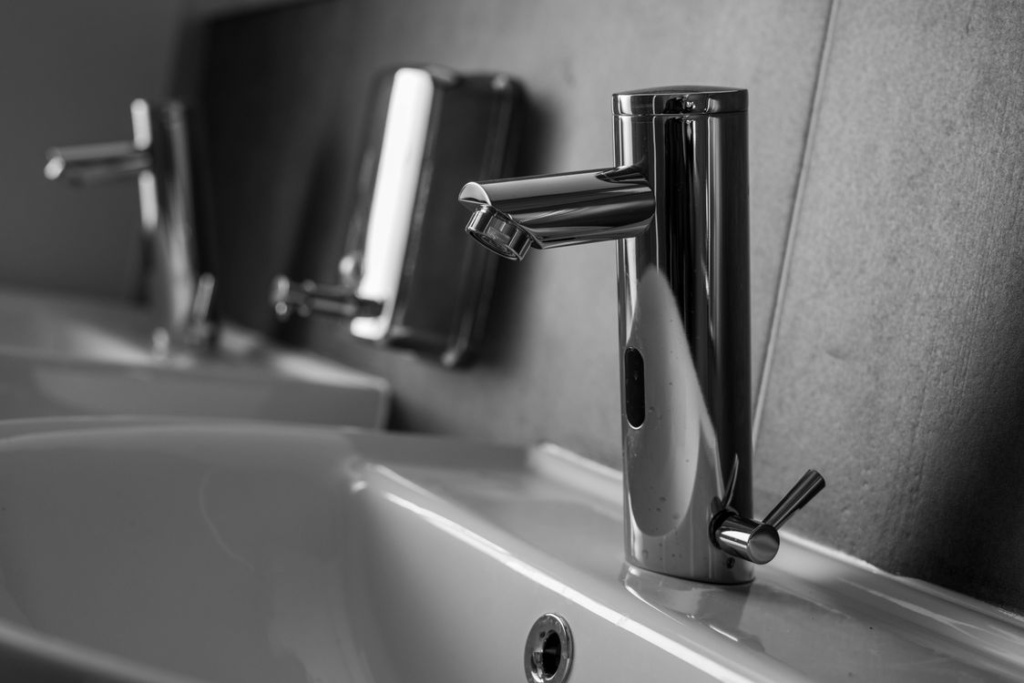
Sensor-activated (or hands-free) faucets are the gold standard for modern restaurant operations.
Automatic faucets use infrared sensors. There are no handles or levers to touch. Simply place your hands underneath and the water will flow. Move them away and the water will shut off.
Here’s why they work so well:
- Water only runs when actually needed
- No water left running while staff prep food
- Better hygiene since hands never touch the tap
- Less cross-contamination in busy kitchens
Showers & sinks: Obviously when it comes to toilets and handwash stations. The employee doesn’t have to remember to turn off the faucet and you aren’t paying for water just sitting there running.
Low-Flow Aerator Faucets
Aerators are small attachments that introduce air into the stream of water. Less water flows out, but it feels like you have plenty.
Switching from a standard 2.2 gpm aerator to a 0.5 gpm aerator can save 1.7 gallons per minute per faucet. Imagine the savings with several handwash stations in restaurants.
The best part?
Aerators are inexpensive (usually less than $10) and simple to install. Aerators provide one of the quickest returns on investment.
Pre-Rinse Spray Valves
These are the heroes of the dish pit.
Pre-rinse spray valves blast food off of plates before they enter the dishwasher. Older models use excess water. Newer models that have the WaterSense label use 1.28 gpm or less.
That’s a significant amount of water savings for a device that operates continuously when in use.
Foot-Pedal Operated Faucets
Foot pedals are an underrated option for prep areas.
Cooks press a pedal with their foot to turn the water on. They release the pedal and it turns off. Translation:
- Hands stay free for prep work
- No water left running between tasks
- Better hygiene control
- Great in tight kitchen spaces
Key Features To Look For
Commercial faucet technology isn’t always what it seems. Here’s what to look for when shopping for energy efficient faucets for your restaurant.
Flow rate (GPM): Less is better — but not too less. Between .5 and 1.5 gpm should be fine for most restaurant jobs.
WaterSense or ENERGY STAR labels: Third party certified. Faucet has been tested to verify water and energy savings.
Solid brass build quality: Restaurants can be tough on fixtures. If it’s made of plastic or flimsy metal it will fall apart. Solid brass can stand up to daily use.
Simple Maintenance: Choose faucets with replaceable cartridges and easily accessible parts. Restaurant equipment fails. It’s just a matter of time.
Temperature control: Mixing valves and preset limits on temperature prevent employees from turning up the hot water full blast and wasting energy.
How To Choose The Right Faucet For Your Operation
So how do you actually pick the right faucet?
Start with this simple process…
- Take inventory of what you have — Walk through your establishment and identify every faucet. What year was each faucet installed? What is the flow rate?
- Spot which areas see the most use — The dish pit, prep sinks and handwash stations take the biggest beating. Focus on these first.
- Match the faucet to the task — Sensor faucets for handwashing, pre-rinse valves for dishwashing, foot pedals for prep areas
- Buy name brands — Bargain bin store plumbing fixtures break easily. Go with name brands you know.
- Figure out the payback period — Energy-efficient faucets usually pay for themselves in 12-24 months with energy and water savings.
The average sit-down restaurant consumes between 3,000 to 7,000 gallons of water per day (the median is around 5,800 gallons). That means even a savings of 20% equates to large annual savings with efficient faucets.
The Bottom Line
Energy-efficient faucets are one of the smartest investments any restaurant owner can make.
They:
- Cut your water bill
- Reduce your energy bill
- Improve hygiene in your kitchen
- Last longer than cheap alternatives
- Help your sustainability story
Plus, the coolest thing is that the payback can be quick. Usually, within a year or two you’ve earned back what you spent on the upgrade through savings on your utility bills.
One more thing — begin with the high traffic areas. Attack the dish pit, handwash stations and prep sinks. Then move on through the restaurant.
You’ll soon ask yourself why you didn’t do this years ago. Start saving money as soon as those new fixtures are installed.